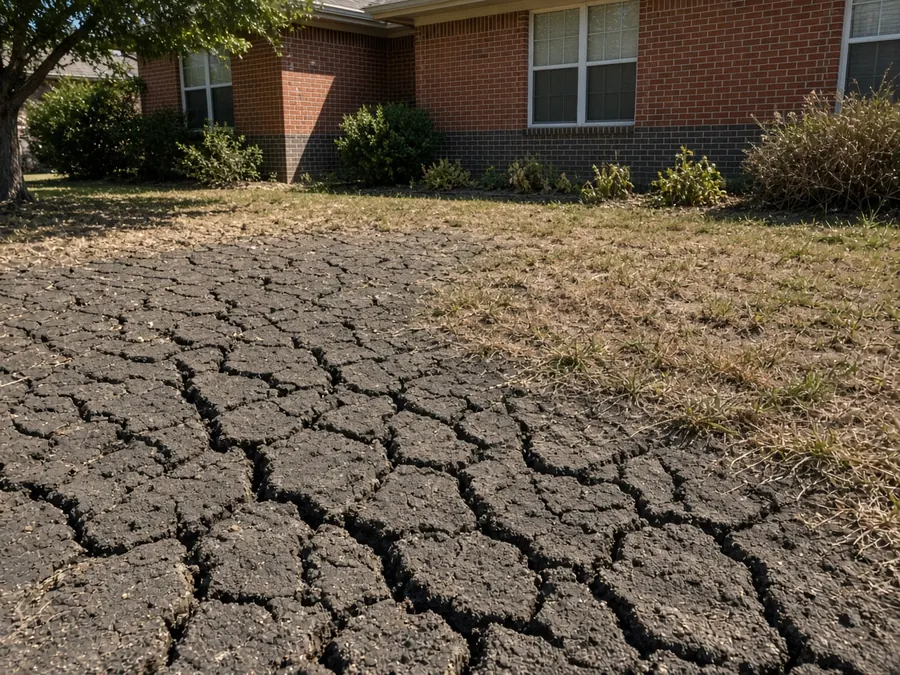
No source we found shows a single best month for foundation repair in Waxahachie. Engineers describe repair as a decision driven by what the measurements show, not by the calendar. Season matters mainly for diagnosis, because clay moves with moisture, and for scheduling, because weather can delay work.
Why people ask: the clay moves with the seasons
Waxahachie’s state soil, Houston Black, shrinks and swells strongly. The USDA series description notes surface cracks 0.5 to 4 inches wide that stay open about 90 to 150 cumulative days in most years. Texas A&M AgriLife Extension describes the cycle in homeowner terms: when clay gets extremely dry it constricts and the foundation can sink, sometimes in different directions, which causes cracks; when the clay receives moisture again it expands and lifts the foundation, sometimes closing the cracks. So the house you measure in September can look different in March.
What that means for timing
- Season is not a reason to delay calling an engineer. The same DFW engineering firm says evaluations can be done year-round with seasonal effects accounted for in the analysis, and that in many cases monitoring across seasons shows whether movement is cyclical or progressive.
- One measurement is one moment. The Texas Section of the American Society of Civil Engineers (ASCE) guidelines say a single floor-level survey “yields the shape of the foundation at one instant” and may not be enough to support a conclusion. They describe repeated floor-level surveys over months or years as a way to see how the shape changes. A survey taken at the end of a drought and one taken after a wet spring can tell different stories.
- Experts disagree on which season risks overcorrection. A Dallas–Fort Worth engineering firm cautions that lifting a house in winter, when soil may already be elevated, risks overcorrecting as the soil dries later, and that summer evaluations show the worst case but can exaggerate cosmetic distress. A Texas contractor-referral site takes nearly the opposite view: leveling to drought-low soil can overshoot once rains return, while a level set in the wet season is less likely to rise further. It adds that late fall through spring usually gives the clearest read for non-urgent cases, and that piers can be installed in any season. Because competent sources disagree, the safer takeaway is to ask the engineer or contractor how the plan accounts for soil moisture, and to ask for the elevation readings in writing.
- Weather affects scheduling more than whether a method works. Angi’s guide to repair timelines notes that the weather can affect repair timing, and that some repairs can’t be completed in freezing temperatures or rainy conditions. That is a reason a job might slip, not evidence that piers installed in one month perform better than another.
When not to wait for the “right” season
Waiting for a better season makes sense for a hairline crack that appeared after a dry spell. It makes less sense when doors that used to latch no longer do, when windows stop operating, when cracks keep widening, or when you suspect a plumbing leak. A leak is not a seasonal effect, and the ASCE guidelines list plumbing testing among the additional investigations an engineer can add. See signs of foundation problems for how to tell the difference, and foundation inspections in Waxahachie for what a written inspection should include.
What you can do in any season
- Record the movement. Photograph cracks beside a ruler and date them. A dated record lets an engineer see whether movement is seasonal or progressing.
- Look at the soil next to the slab. AgriLife advises walking around the house: a visible gap between soil and foundation means the soil is dry and may need watering. The same document describes soaker hoses placed 8 to 18 inches from the foundation, with a backflow preventer on the faucet. Our drainage and foundation care page explains why one-sided watering can backfire.
- Get the quote in writing. A seasonal rush is a common reason to sign quickly. Use the quote checklist before you do.
- After a drought. Our dry-spell page covers what homeowners typically see when the clay reswells.
The ASCE guidelines also state that non-structural measures, such as controlling soil moisture, and then monitoring performance may be a prudent approach before or instead of structural repair. Whether that applies to your house is something to ask whoever inspects it.
Sources cited on this page
- USDA Official Soil Series Description, Houston Black (revised 08/2017)
- Texas A&M AgriLife Research and Extension (Dallas), Protecting Foundations Under Dry Conditions (PDF)
- Texas Section ASCE, Guidelines for the Evaluation and Repair of Residential Foundations, Version 3 (2022, PDF)
- Thomas Engineering Consultants (DFW), Winter vs. Summer Foundation Repairs
- Thomas Engineering Consultants (DFW), Seasonal Foundation Maintenance in Texas
- Texas Tough Foundation Repair (Texas contractor-referral site, updated 9 Nov 2026), Best Time of Year for Foundation Repair in Texas
- Angi, How Long Does Foundation Repair Take? (updated 9 Jul 2026)